Three problems the edge always hits, and how FORGE answers each.
Links fail. The connection doesn't.
FORGE OS bonds every uplink into one pipe, not just for resiliency but for capacity too. It degrades gracefully instead of dropping, and fine-tuned scheduling keeps lossy satellite links usable where ordinary TCP collapses. A single link can fail and your TCP session stays up, completely uninterrupted.
Encrypted end to end. Closed by default.
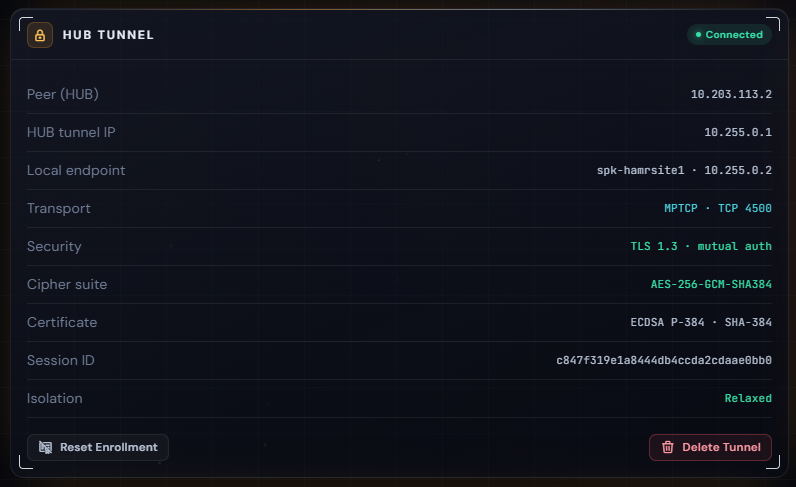
Every tunnel is TLS 1.3, mutually authenticated, AES-256-GCM, running in a FIPS 140-3 validated module, enforced, never optional. Isolation is fail-closed: lose the tunnel and the site stops forwarding. Routing isn't authorization: an allowlist gates every transiting packet, and revoking a site takes effect immediately — the hub drops that spoke’s live tunnel on the operator’s action, rather than leaving it connected until it next checks a list. And FORGE needs no path back to us: licensing validates offline, and no telemetry ever leaves your network.
Networking a non-expert can run.
Plain-English status, not daemon output. One honest signal: green means it's truly working, not just plugged in. It even catches the silent killer: "tunnel up, learning no routes" reads amber, never a false green.
Enterprise services: pushed, not configured.
The FORGE HUB pushes NTP, DNS, authentication, syslog, and SNMP down to every spoke automatically. Your field operator never hand-configures a single enterprise service connection. The whole policy set arrives with enrollment and stays in sync from the HUB. The NOC also gets an offline geographic Fleet Map, served from signed, customer-installed map packs, so no external mapping service ever sees your fleet.
Every link, bonded into one encrypted path.
Each HAMR field spoke bonds every WAN link the site has, up to four at once: Starlink, LTE, fiber, GEO sat. FORGE bonds them into a single mutually-authenticated tunnel back to the FORGE HUB, so losing any one link never drops the session.
Real numbers, through the full encrypted stack.
Aggregation efficiency is the real throughput FORGE delivers as a share of the links' combined theoretical ceiling. Two 250 Mbps WANs give a 500 Mbps ceiling; FORGE bonds them to ~435 Mbps of usable, encrypted capacity, about 87%.
We break it on purpose. Here's what happened.
Every number below comes from a failure we inflicted deliberately on a live system, and we will happily inflict it again in front of you.
Built for the places connectivity can't fail.
Let's forge your edge network.
Resilient, encrypted, and simple enough that your field team runs it, cutting your NOC's time-to-resolution. Book a pilot or request a live demo.