HAMR-FORGE, LLC  ·  FORGE OS

It answers to you.

FORGE OS bonds every link a site has (Starlink, LTE, fiber, GEO) into one encrypted connection — brought online by the people already at the site, not by a field engineer you fly in.

Book a pilot See how it works Datasheet (PDF)
Installed by your own staff  ·  Encrypted end to end
No cloud, no license check, no phone home
HAMR-FORGE
Built for Command posts· Critical infrastructure· State & local gov· Expedition & maritime
Why FORGE

Three problems the edge always hits, and how FORGE answers each.

01 / Resiliency

Links fail. The connection doesn't.

FORGE OS bonds every uplink into one pipe, not just for resiliency but for capacity too. It degrades gracefully instead of dropping, and fine-tuned scheduling keeps lossy satellite links usable where ordinary TCP collapses. A single link can fail and your TCP session stays up, completely uninterrupted.

LTE / 5G GEO Sat TUNNEL AES-256 HUB
02 / Security

Encrypted end to end. Closed by default.

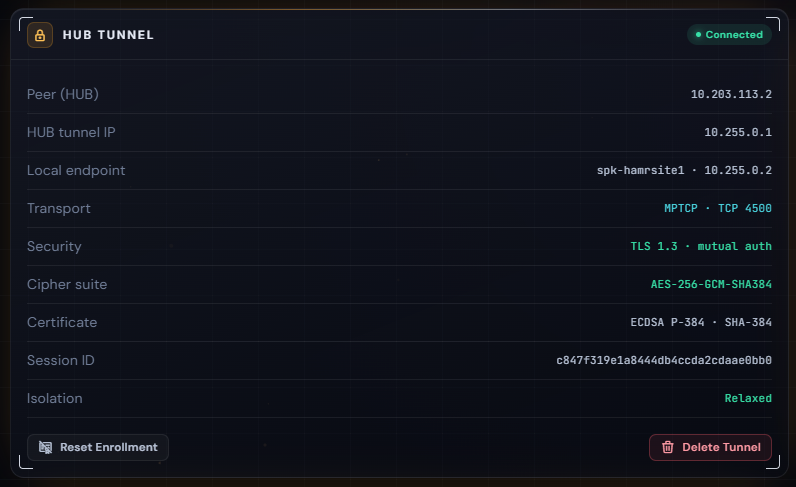
Every tunnel is TLS 1.3, mutually authenticated, AES-256-GCM, running in a FIPS 140-3 validated module, enforced, never optional. Isolation is fail-closed: lose the tunnel and the site stops forwarding. Routing isn't authorization: an allowlist gates every transiting packet, and revoking a site takes effect immediately — the hub drops that spoke’s live tunnel on the operator’s action, rather than leaving it connected until it next checks a list. And FORGE needs no path back to us: licensing validates offline, and no telemetry ever leaves your network.
TLS 1.3 AES-256-GCM Mutual auth FIPS 140-3 module (CMVP #5247) Zero phone-home
FORGE OS tunnel - MPTCP transport, TLS 1.3 mutual authentication, AES-256-GCM-SHA384, ECDSA P-384
03 / Simplicity

Networking a non-expert can run.

Plain-English status, not daemon output. One honest signal: green means it's truly working, not just plugged in. It even catches the silent killer: "tunnel up, learning no routes" reads amber, never a false green.

A field operator localizes the fault and hands the NOC exactly what's wrong, turning truck rolls into two-minute fixes.
FIELD STATUS
operator view
Internet is reachable
OK
Encrypted tunnel is up
VERIFIED
Learning routes…
tunnel up, 0 routes yet
CHECK
Amber means honestly not-ready, never a false green.
04 / SD-WAN Automation

Enterprise services: pushed, not configured.

The FORGE HUB pushes NTP, DNS, authentication, syslog, and SNMP down to every spoke automatically. Your field operator never hand-configures a single enterprise service connection. The whole policy set arrives with enrollment and stays in sync from the HUB. The NOC also gets an offline geographic Fleet Map, served from signed, customer-installed map packs, so no external mapping service ever sees your fleet.

FORGE HUB
PUSHES CONFIG
NTP
DNS
Authentication
Syslog
SNMP
HAMR Spoke
● RECEIVES AUTOMATICALLY
How It Works

Every link, bonded into one encrypted path.

Each HAMR field spoke bonds every WAN link the site has, up to four at once: Starlink, LTE, fiber, GEO sat. FORGE bonds them into a single mutually-authenticated tunnel back to the FORGE HUB, so losing any one link never drops the session.

WAN LINKS HAMR field spoke Starlink / LEO LTE / 5G Fiber / Cable GEO Sat BONDED TUNNEL MPTCP · TLS 1.3 AES-256-GCM FORGE HUB NOC · Upstream
MPTCP bonding· Mutual-auth TLS· Fail-closed isolation· Low-touch enrollment · NOC-approved
Proven Performance

Real numbers, through the full encrypted stack.

Aggregation efficiency is the real throughput FORGE delivers as a share of the links' combined ceiling, measured on real FORGE boxes with QoS on Auto and calls, mission data and video running at the same time. Two 250 Mbps WANs give a 500 Mbps ceiling; FORGE delivered 442 Mbps of usable, encrypted capacity, about 88%.

Bonding across real link mixes
Download · round trip per link · FORGE OS 1.1
Two 250 Mbps links
442 of 500 Mbps
30 ms + 30 ms
88%
1 Gbps fiber + 250 Mbps
1,110 of 1,250 Mbps
2 ms + 38 ms
89%
1 Gbps fiber + 40 Mbps LTE
927 of 1,040 Mbps
10 ms + 50 ms
89%
LTE pair, 25 + 40 Mbps
57 of 65 Mbps
40 ms + 50 ms
88%
Starlink profile + 40 Mbps LTE
157 of 190 Mbps · dish delay shifts every 15 s, 0.4% loss
emulated dish
83%
GEO satellite ~600 ms → bulk stays off it, calls ride it
Too slow to bond without dragging the whole connection down, so FORGE keeps bulk traffic on the faster links. Your calls and mission data are still copied onto it, every packet, so if the other links fail they are already there.
With every link full, no call, mission data or video packet was lost or late on any of the five link mixes above. Auto holds back 5% of what the links carry to make that true. Uploads measured 86-90% on the fast mixes and 80-88% on the LTE pair.
Measured on our lab fleet, each link's speed and delay set by a WAN emulator · Starlink figures are emulated until our field trial · live-radio field trial is the next milestone.
Break-tested

We break it on purpose. Here's what happened.

Every number below comes from a failure we inflicted deliberately on a live system, and we will happily inflict it again in front of you.

01
A WAN dies mid-stream
even with its link light still green
The session stays up and bulk moves to the surviving links in 1-2 seconds. Calls and mission data keep going on the other links: every packet was already being sent on every link.
02
Every link at a site goes dark
a full outage, then the links return
Back the moment the links are: the tunnel in 1.3 seconds typically, calls answering in 3.8 seconds, both links carrying within a second of each other. Measured over 30 full outages.
03
Lose the home hub entirely
a change of hub, not a path event
The spoke proves the outage across every WAN, moves itself to its assigned standby, and reconverges routing. Measured from a client at a BGP site: back in about 30 seconds. Automatic, no operator input — and a planned hub reboot doesn't trigger it at all. Coming home is scheduled by your NOC, never automatic.
04
Fill every link
calls, mission data and video running
Nothing lost or late. At steady full load on every link mix we tested, not one call, mission data or video packet was lost or late. Auto keeps the queue inside FORGE, where priority traffic goes first.
05
A flapping link
5 drops in 60 seconds
Automatically benched with escalating probation, reinstated only after proving itself clean. A single short drop isn't a flap: a link that drops for 3 seconds carries again 6-8 seconds after it returns.
06
A link going bad but staying up
link light green, the link sick
Bulk moves off a link with 4% loss in 18-20 seconds, and off one 200 ms slower in 9-25 seconds. Calls and mission data stay on time throughout, because they are copied on every link.
07
Config change under load
Edit any WAN live. Zero interruption. We test this on purpose so you never discover it by accident.
every result reproducible · live-fire demo on request · bring your own cable to cut
Who It's For

Built for the places connectivity can't fail.

01
Command Posts & Operations Centers
Fixed and mobile operations centers, where the coordination and reporting traffic has to survive a bad uplink.
02
Critical Infrastructure & Utilities
Remote sites and SCADA links that simply can't drop.
03
State & Local Government
Field offices and mobile units, centrally governed.
04
Expedition, Media & Maritime
Production crews and vessels far past reliable coverage.
Get Started

Let's forge your edge network.

Resilient, encrypted, and simple enough that your field team runs it, cutting your NOC's time-to-resolution. Book a pilot or request a live demo.

@ Emailinquiries@hamr-forge.com
☎ Call(706) 910-7952
HAMR-FORGE, LLC · Grovetown, Georgia
Your message goes straight to our team. We reply within one business day.